Protests took place in Tel Aviv, Jerusalem, Haifa, and Beersheba, as a survey found broad but uneven support among Jewish Israelis for Operation Roaring Lion.
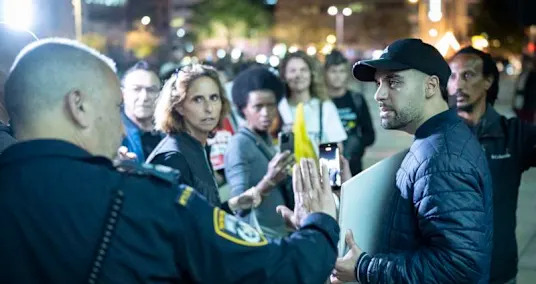
Israel Police arrested 21 anti-war protesters Saturday night as demonstrations against the conflict with Iran expanded in multiple cities despite restrictions on public gatherings.
Protests took place in Tel Aviv, Jerusalem, Haifa, and Beersheba, with hundreds of participants reported in Tel Aviv and Jerusalem and about 100 in Haifa, marking the largest turnout since weekly demonstrations began. Authorities said 13 people were arrested in Tel Aviv and eight in Haifa.
Police said the gatherings were not approved under Home Front Command regulations that ban events with more than 50 people. Officials said the increase in turnout followed calls by groups opposing the government to protest despite the restrictions.
“During a situation assessment that took place at the scene with a Home Front Command representative… it was clarified that there was a real risk to human life and accordingly, Yarkon [precinct] police commander Tzachi Sharabi ordered the gathering to be dispersed,” police said.
Hadash-Ta’al chairman Ayman Odeh, an Arab lawmaker involved in the protests, criticized the police response, calling officers fascists “in the service of the government” and saying they were afraid of “the heroic citizens who went out, despite everything, to make their voice heard.”

Survey shows broad, uneven support for war
The demonstrations come as a March 2026 survey by the Israel Democracy Institute found broad but uneven support among Jewish Israelis for Operation Roaring Lion. Support was strongest on the Right at 87% and about half on the Left.
The survey also found that Jewish and Arab respondents largely agreed that Iran’s resilience has been stronger than expected. Most Jewish respondents said Israeli society could sustain the campaign for up to one month, while 28% said as long as needed. Arab respondents were less optimistic about how long the public could endure the conflict.
A majority of Jewish respondents said Prime Minister Benjamin Netanyahu’s decision was driven by security considerations, while most Arab respondents viewed it as political.
latest_posts
- 1
 OpenAI launches ChatGPT Health to connect medical records, wellness apps
 - 2Explainer-What will change with the US reclassification of marijuana?
- 3Instructions to Perceive and Grasp the Early Side effects of Cellular breakdown in the lungs
- 4Rescuers again fail to free whale stranded on Germany's Baltic coast
- 5NASA's giant moon rocket, in photos


- Melodic Combination d: A Survey of \Unrecorded Music Energy\ Show
- Home Mechanization Frameworks for Brilliant Residing
- How much should a kid's birthday party cost? One mom spent $190 for pizza and ice cream at a park. Another paid $2K for a playspace and goodie bags.
- Why haven’t humans been back to the moon in over 50 years?
- Cameroon says Russia has confirmed 16 Cameroonian soldiers died in Ukraine
- Vote in favor of your #1 sort of juice
- Burkina Faso must 'forget' about democracy, military leader says
- The 1st full moon of 2026 rises tonight! Here's what to expect from January's supermoon Wolf Moon
- How to watch Dick Clark’s New Year’s Rockin’ Eve with Ryan Seacrest: Start time, TV channel, performers and more