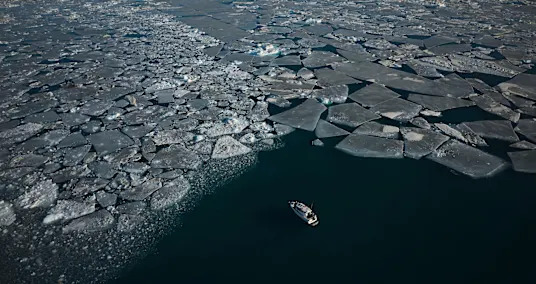
WASHINGTON (AP) — Vital Arctic sea ice shrank to tie its lowest measured level for the winter, the season when ice grows, as a warming Earth shattered records across the continents.
Arctic sea ice levels, especially in the summer, are crucial to Earth's climate because without the ice reflecting sunlight, more heat energy goes into the oceans. Ice of all kinds around the poles acts as Earth's refrigerator. Wildlife, such as polar bears and seals, also depend on sea ice. Lack of sea ice in the Arctic creates new shipping routes and in doing so causes geopolitical disruptions, making once-ignored places such as Greenland, more desirable.
The shrinking Arctic sea ice was announced Thursday as temperatures broke March heat records across the United States, all over Mexico, in Australia, across Northern Africa and through parts of Northern Europe. Climatologist and weather historian Maximiliano Herrera, who tracks extreme temperatures, called the extreme March temperatures “by far the most extreme heat event in world climatic history” and said on social media that the next few days would be “much worse.”
Sixteen states broke March temperature records in the past week or so, said weather historian Christ Burt. Twenty-seven locations had temperatures in the past week high enough to tie or surpass the hottest April day on record, including St. Louis, meteorologists said. Mexico has had thousands of records shattered, some of them warmer than the hottest May temperatures, but that's nothing compared with what's happening in Asia, where “dozens of thousands of monthly records” were smashed by 30 to 35 degrees (17 to 19 degrees Celsius) margins, Herrera said.
Yet at the same time earlier this week, Antarctica set a record for the coldest March day anywhere on Earth at minus 105.5 degrees (minus 76.4 degrees Celsius), according to Herrera and Burt.
Steady decline of sea ice
Each year Arctic sea ice grows over the cold winter and shrinks in the heat of the summer. This year the growth was so small that its peak, before starting to shrink, measured 5.52 million square miles (14.29 million square kilometers). That's slightly smaller than last year's 5.53 million square miles (14.31 million square kilometers), but the National Snow and Ice Data Center, which does the measuring, considers those two figures so close that it's a tie.
This year's sea ice area was about 525,000 square miles (1.36 million square kilometers) lower than the 1981 to 2010 winter average peak. That's about twice the size of Texas.
“As temperatures have warmed and are continuing to warm, especially in the polar region, there is less opportunity to grow ice and it’s gonna tend to, on average, be less,” said data center senior scientist Walt Meier. “It’s not like we are seeing a regime shift or anything. It’s more of a steady decline in the winter and at the maximum. And it also gives us a head start on the summer melt season. We’re starting from a lower number.”
Summer sea ice is key
The summer melt season — which precedes a September measurement known as the Arctic sea ice minimum — is “really the critical time,” Meier said. One reason is that when there's less white ice reflecting the strong summer sun, the oceans can absorb more heat. And when that happens, the Arctic warms closer to temperatures further south and atmospheric pressure changes. A leading theory — that is still controversial — says those Arctic changes then alter the movement and shape of the jet stream, which moves weather west to east and contributes to extreme weather bursts, he said.
Melting sea ice does not contribute to sea level rise.
Winter sea ice growth season is also more variable with weather changes, so just because the Arctic hits a record small amount in March, it doesn't mean that the summer will be record low, Meier said.
“The winter maximum is certainly interesting,” Meier said. “It is, I'd say, a climate change global warming signal.”
On the other end of the planet, Antarctic sea ice is heavily affected by local weather and ocean factors. In February, Antarctica hit its annual low point and while it was smaller than the 30-year average, it was nowhere near the record low levels of the past three years, Meier said.
___
The Associated Press’ climate and environmental coverage receives financial support from multiple private foundations. AP is solely responsible for all content. Find AP’s standards for working with philanthropies, a list of supporters and funded coverage areas at AP.org.
latest_posts
- 1
 Hamas demanded displaced Gazans pay rent on beach tents amid torrential downpour, IDF reveals
 - 221 Things You Ought to Never Share with Your Childless Companion
- 3Governments take targeted action as fuel prices hit retail
- 4‘Democratizing space’ is more than just adding new players – it comes with questions around sustainability and sovereignty
- 5Fundamental Venture The board Apparatuses for Remote Groups




- From record warming to rusting rivers, 2025 Arctic Report Card shows a region transforming faster than expected
- Former biotech CEO sued over COVID vaccine alleged insider trading
- This St Nick Truly Can Advise How To Drink And Hack Your Headache
- What's an atmospheric river? AP explains the weather phenomenon
- We analyzed Philly street scenes and identified signs of gentrification using machine learning trained on longtime residents’ observations
- Carnival fever hits Lagos as locals celebrate Afro-Brazilian heritage
- A hospital discharged a woman in labor. This lawmaker wants change.
- One third of Spanish pork export certificates blocked since swine fever outbreak, minister says
- Vote in favor of Your #1 Climbing boots Now