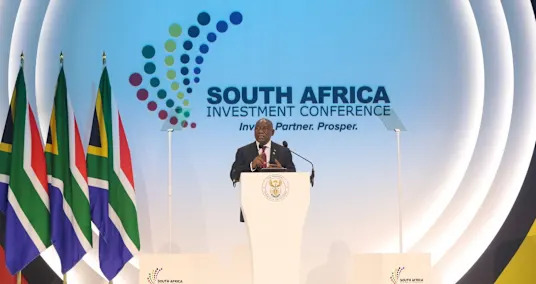
South African President Cyril Ramaphosa launched a nearly $200 billion investment drive aimed at accelerating economic recovery and industrialization in the face of growing worry over the impact of the Iran war on the continent’s biggest economy.
For more than a decade, South Africa’s economy has barely grown, leaving it with crumbling infrastructure and the need to create jobs in a country where one in three people are unemployed. Ramaphosa’s pitch to investors in Johannesburg this week was that South Africa has fixed the worst bottlenecks: He said the country is opening key sectors to private capital and is ready for large scale investments.
Ramaphosa said the effort will run through 2030 with delegates at the South African Investment Conference pledging $53 billion across 31 projects spanning energy, logistics, manufacturing, and digital infrastructure. They include Coca-Cola’s $1 billion expansion plan, and a $3.6 billion commitment from Sasol — the world’s biggest maker of fuel from coal — to upgrade operations.
latest_posts
- 1
 Remain Fit: Powerful Wellness and Work-out Schedules for a Better You
 - 2Russia Fields New Ulan-2 All-Terrain Tactical Vehicle
- 3Health officials report 14 Legionnaires' disease cases in Florida, gym connection suspected
- 4Manual for Purchasing a Modest Jeep Wrangler for Seniors
- 5Only 30% of young people in Israel optimistic about future, Aluma survey reveals



- 7 Moves toward a Sound and Dynamic Way of life
- Space Condos to Lift Your Metropolitan Living
- The 10 Most Noteworthy Games in History
- Vote in favor of Your Number one Smartwatch: Exactness and Style Matter
- Iranian-linked drone attack kills Kurdish couple in northern Iraq
- Tatiana Schlossberg, a granddaughter of JFK, is dead at 35 after cancer diagnosis
- Elanco's drug gets emergency nod to treat deadly flesh-eating parasite in cats
- Hamas urges Hezbollah to kidnap Israeli soldiers in wake of Knesset passing death penalty bill
- Astronauts beam home Christmas wishes from International Space Station: 'I think we may be orbiting a little higher than Santa' (video)